

"Published in Vacaville, California, USA"
The trough shown in the figure has triangular ends which lie in parallel planes. The top of the trough is a horizontal rectangle 20 in. by 33 in., and the depth of the trough is 16 in.
(a) How many gallons of water will it hold? (One gal. = 231 cu. in.)
(b) How many gallons does it contain when the depth of the water is 10 in.?
(c) What is the depth of the water when the trough contains 3 gals.?
(d) Find the wetted surface when the depth of the water is 9 in.
 |
| Photo by Math Principles in Everyday Life |
Solution:
(a) Consider the given figure above
|
| Photo by Math Principles in Everyday Life |
The area of the base is


Therefore, the volume of a trough when filled with water which is the volume of a prism is



The volume of a trough in gallons is


(b) Consider the front side of a trough
 |
| Photo by Math Principles in Everyday Life |
Bu using similar triangles, the area of the base with water is


Therefore, the volume of a trough with water is


The volume of a trough with water in gallons is


(c) The volume of a trough with water in cubic inches is


The area of the base of a trough with water is


By using similar triangles
 |
| Photo by Math Principles in Everyday Life |
Therefore, the depth of water in a trough is


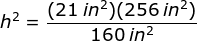


(d) Consider the front side of a trough
 |
| Photo by Math Principles in Everyday Life |
By using similar triangles, the length of the base is


Let's assume that the base of a trough is an isosceles triangle.
 |
| Photo by Math Principles in Everyday Life |
By using Pythagorean Theorem, the length of the wetted edge is


The lateral area of the wetted surface of a trough is


Therefore, the total area of the wetted surface of a trough is


